What preprocessing buys
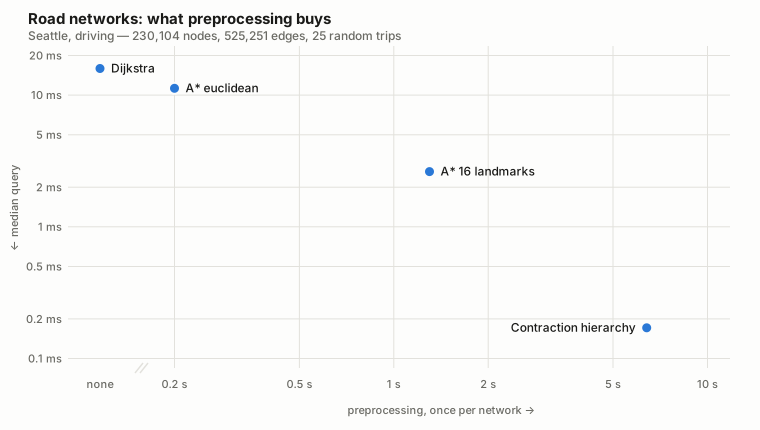
Every technique on this shelf answers the same question. What separates them is when they spend: some do nothing until asked and then search hard, others spend minutes rewriting the network so that a query barely searches at all.
These are the two axes. Preprocessing is paid once per network, at bind.
Query is paid once per question, and is the median over a set of random
trips. Both are logarithmic, because the classes span four orders of magnitude
in each direction, and a linear axis would put half the shelf on top of the
origin.
Down and to the left is better. A point down and left of another is faster in both senses, and the technique it beats is dominated — which does happen, and is worth naming when it does. The corner nobody occupies is the bottom left: a fast query with no preprocessing. That empty space is the whole subject of the literature these pages describe.
Every row within a chart comes from one run on one instance, and each benchmark checks that all of its techniques return the same answers before it reports a time — a row that got faster by getting a different answer fails the benchmark rather than appearing here.
Road networks
| technique | preprocessing | memory | settled | median query |
|---|---|---|---|---|
| Dijkstra | none | — | 115,698 | 15.931 ms |
| A* euclidean | 0.2 s | 4 MB | 55,250 | 11.261 ms |
| A* 16 landmarks | 1.3 s | 29 MB | 9,370 | 2.626 ms |
| Contraction hierarchy | 6.4 s | 17 MB | 247 | 0.171 ms |
A clean frontier, and the tidiest result on this page: each step costs more preprocessing than the last and returns a faster query, in the order the literature produced them. Nothing here is dominated.
Dijkstra sits in the "none" slot at the left rather than at zero, because a log axis has no zero and pretending its preprocessing is very small rather than absent would be a quiet lie about a real difference in kind — it has no preprocessing step at all.
The span is the thing to look at: six seconds of contraction buys a query 93× faster than the one it started from. The settled column says why — 247 nodes touched instead of 115,698, on a network of 230,104.
Timetables
| technique | preprocessing | memory | settled | median query |
|---|---|---|---|---|
| TimeDependent | 0.6 s | 11 MB | 3,256 stops | 3.874 ms |
| TimeExpanded | 1.4 s | 150 MB | 66,447 events | 14.785 ms |
| RAPTOR | 0.4 s | 16 MB | 4,126 stops | 1.192 ms |
| CSA | 0.4 s | 25 MB | 3,411 stops | 0.668 ms |
| TripBased | 14.5 s | 28 MB | 8,455 trips | 1.050 ms |
| PTL | 61.3 s | 1,165 MB | 12,973 hubs | 0.495 ms |
| ULTRA(RAPTOR) | 29.2 s | 15 MB | 6,179 stops | 1.917 ms |
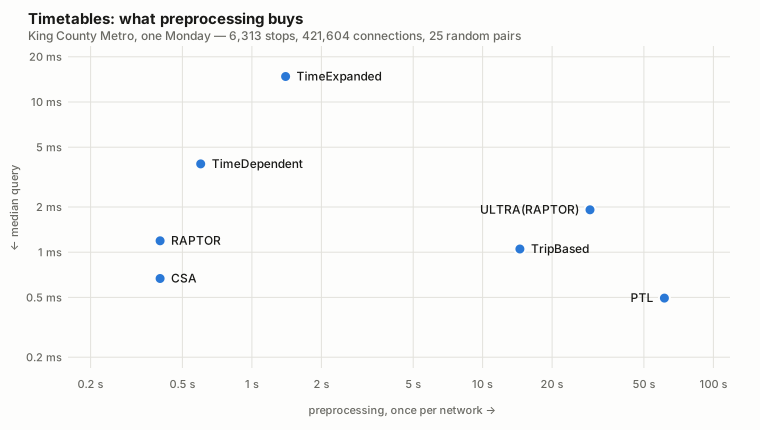
Not a frontier — a scatter, and the interesting one on this page.
TimeExpanded is dominated outright. It costs three times TimeDependent's preprocessing, a hundred and fifty megabytes against eleven, and answers seven times slower. That is not a failure of the implementation; it is the paper's own trade, stated honestly. A node per event turns the timetable into an ordinary graph that any stock shortest-path search can route — and on a city's weekday that means 837,924 nodes, which is what a query then has to search. You buy simplicity and generality, and pay in size.
CSA is the surprise. It spends the same 0.4 s the graph models spend and answers faster than TripBased, which spent twelve seconds precomputing transfers. Sorting 421,604 connections into one array and scanning them turns out to be extremely hard to beat on a city-sized instance — "intriguingly simple", as the title has it.
PTL is at the far corner, and its axis is the wrong one. Its query is the fastest here, but the number that decides whether you can use it is not on this chart: 1,165 MB, against 11–28 MB for everything else. The scatter shows time against time; on memory PTL is forty times its nearest neighbour.
ULTRA is not comparable, and is drawn anyway. It appears here because it was measured in the same run, but it is solving a harder problem than the rows around it: unlimited walking transfers rather than transfers within a fixed radius. Twenty-nine seconds of preprocessing to answer in 1.9 ms what the RAPTOR underneath answers in 1.2 ms is not a bad showing — it is a technique paying for a capability this instance does not need, because a transitively closed 200 m footpath set is already the thing ULTRA exists to avoid needing. The chart where it earns that is the next one.
Multimodal
| technique | preprocessing | memory | median query |
|---|---|---|---|
| LabelConstrained | 0.4 s | 14 MB | 106.724 ms |
| UCCH | 189.3 s | 66 MB | 34.791 ms |
| ULTRA(RAPTOR) | 612.6 s | 149 MB | 11.445 ms |
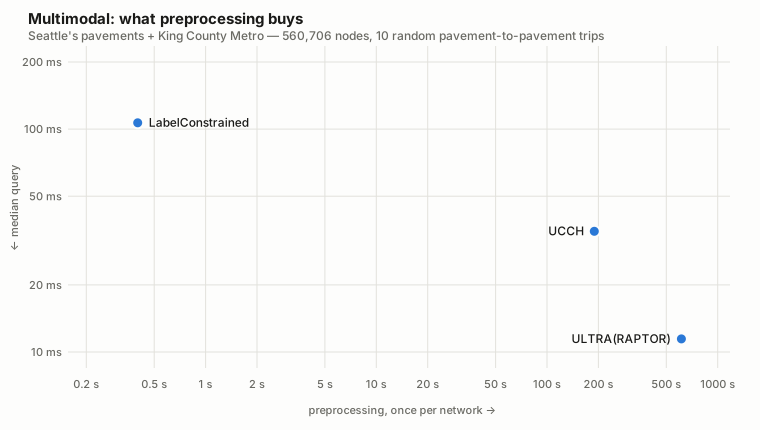
A harder instance than the two above: 560,706 nodes of pavement and timetable joined by link arcs, and every trip starts and ends on the street rather than at a stop. All three return the same arrivals on all ten trips.
This is the page's cleanest frontier, and the three corners the multimodal pages describe. Precompute nothing and search the whole network: 107 ms. Contract the pavement for three minutes and search a core: 35 ms. Work out every transfer a journey could want, for ten minutes, and answer in 11 ms. Each step buys almost exactly what it pays for.
UCCH does what it claims — 3.1× faster than searching the whole network, close to the ~3.5× the UCCH page quotes and, as that page says, near its ceiling: what remains is the transit search inside the core, which UCCH does not touch.
ULTRA lands where the paper says it should. The published ULTRA-RAPTOR answers Switzerland in 12.5 ms; this answers Seattle with King County Metro in 11.4. It did not always: this chart used to show 849 ms, and the three things that were wrong are worth naming, because each was an implementation detail rather than anything the paper left vague.
- The walks at either end were two unbounded Dijkstras over the whole street graph. §4.1 answers them with Bucket-CH, and now so does this.
- The wrapped RAPTOR was bound to the merged network, so its tables held a row per street corner — 560,706 of them, nine rounds a query — where the paper runs the black box on the transit network, 6,313 stops.
- The shortcuts were being closed under composition before the technique read them. A radius's foot-edges are a scatter of small components and closing them is cheap; ULTRA's shortcuts span the network, and closing 24,554 of them made 230 MB of walks no journey takes. They are already the set a query needs — that is the paper's whole guarantee — so they go in as they are.
Together those took the query from 849 ms to 11.4 and the footprint from 374 MB to 149. Nothing about the answers changed: the three techniques agreed before and agree now, which is the only reason the changes could be made with any confidence.
What ULTRA still costs is the ten minutes up front — a core contraction, the shortcut search over it, and a second full contraction for the buckets — and 149 MB to hold the result. That is the trade, and on this instance it is worth it three times over.
Reproducing these
Each chart is one command, and every number on this page came from these three on one machine — an Intel Core i9-8950HK, macOS 15.7.4, routelab 0.1.0:
python benchmarks/bench_contraction.py data/Seattle.osm.pbf --trips 25
python benchmarks/bench_transit.py data/kcm.zip --date 2026-08-17 --pairs 25
python benchmarks/bench_multimodal.py data/Seattle.osm.pbf data/kcm.zip \
    --date 2026-08-17 --pairs 10
The extracts are not in the repository — data/ is ignored, and everyone
fetches their own from Geofabrik or
BBBike and their own feed.
The shape is the point, not the absolute values. Another machine will move
every point by some constant factor, which on a log axis slides the whole cloud
without changing what it says. What would change the shape is a different
network: a smaller city compresses the preprocessing axis, and a feed with
denser service moves the timetable techniques relative to each other. The
numbers live in docs/measurements.json with the commands
that produced them; docs/plot.py redraws the charts from it.
See also
- The shelf — every paper implemented here, with a page each.
benchmarks/— the scripts, which check agreement before they report a time.